
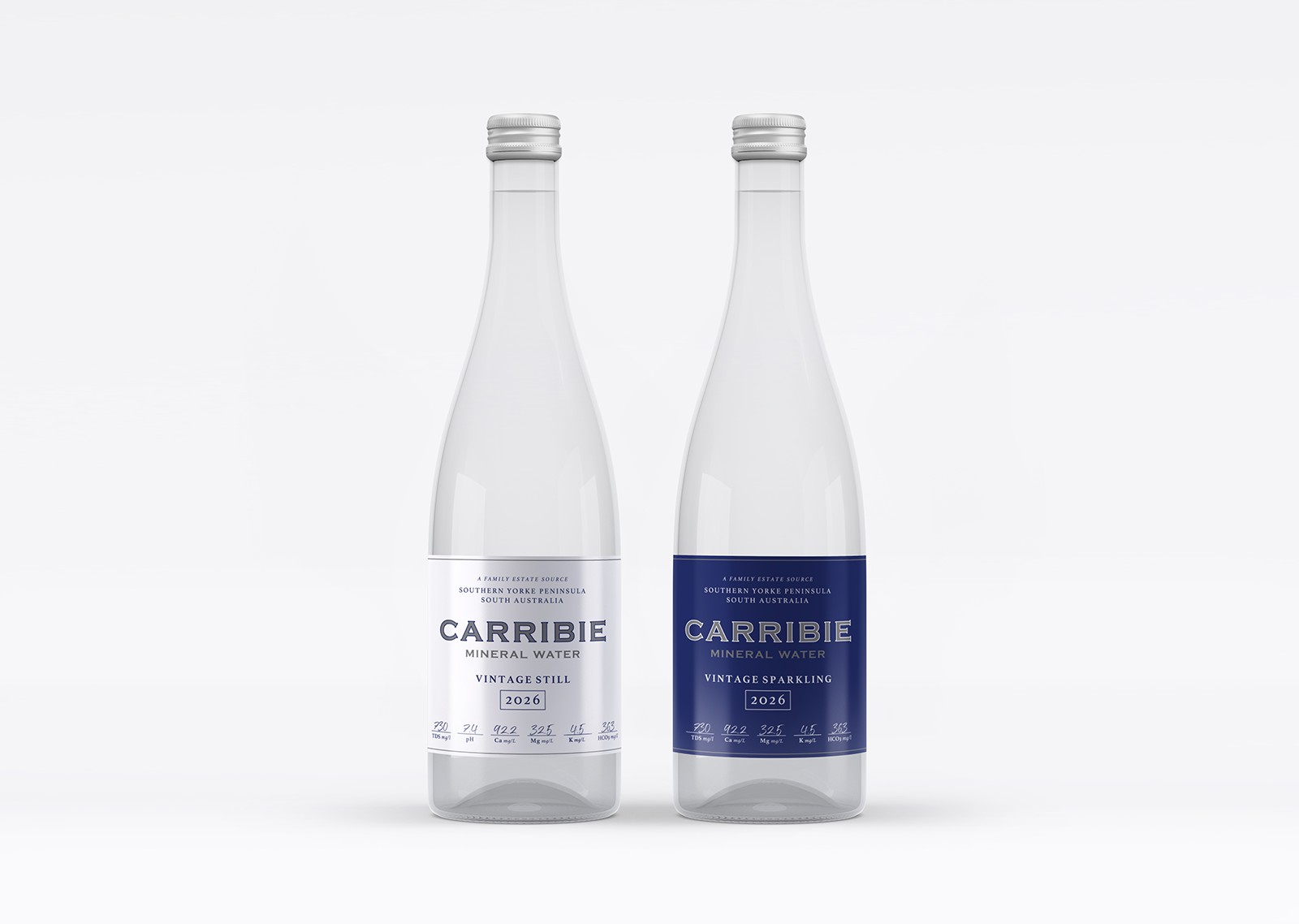
Carribie Water Analysis:
| Balance | Still & Light |
| Virginality | |
| Minerality | Medium |
| Orientation | Hint of Sweet |
| Hardness | Very Hard |
| Vintage | |
| Carbonation | Added |
| TDS | 730 mg/l |
| ph factor | 7.4 |
| Hardness | 362 mg/l |
| Nitrate | |
| Calcium | 92 mg/l |
| Magnesium | 33 mg/l |
| Sodium | 141 mg/l |
| Potassium | 5 mg/l |
| Silica | mg/l |
| Bicarbonate | 363 mg/l |
| Sulfate | |
| Chloride | |

Carribie is a Member of the Fine Water Society |
|
| Source: | Artesian |
| Location: |  |
| Country of Origin: | Australia |
| Region: | Yorke Peninsula |
| Place: | White Hut |
| Established: | 2019 |
| Company: | Carribie |
| Status: | Active |
| Web Site: | carribie.com |
| phone: | +61431966500 |
| email: | |
| Social Media: |   |
Carribie Estate lies beneath the coastal dune systems on the southern edge of South Australia’s Yorke Peninsula, looking out to the Great Southern Ocean. It is a place of distance and quiet permanence—geologically stable, shaped less by development than by wind, sea, and time. Winter rains fall onto ancient aeolian calcarenite: dunes built grain by grain over millennia, fine marine sands pressed and bound into soft limestone. Through calcareous layers of sand, shell fragments, and dense limestone foundations laid down some 540 million years ago, water moves with deliberate slowness—filtered, buffered, and steadily refined as it descends.
Below, the Carribie Basin aquifer holds that water in long repose, where it rests, evolves, and reaches equilibrium. It is not merely a romantic notion of purity; it is a source with early scientific provenance, formally recorded in a 1966 South Australian Government hydrogeological study that described a naturally recharging freshwater limestone aquifer of “excellent quality.” From that rare combination—remote recharge, stable geology, and measured validation—Carribie emerges as a modern custodian of an old system. Named /ka/reh/bee/, “where emus drink,” the brand anchors itself to the living ecology above and the structured reserve below: Estate Mineral Water from Yorke Peninsula, South Australia—because not all water is the same, and fewer still are shaped by a landscape this patient.